Ramon Romein Photography

Some photographers raise their camera the moment they walk into a location. Ramon does not. First, he observes. He listens. He asks questions. Only when he understands what a photograph needs to communicate does he begin thinking about how to capture it.

That may sound obvious, but in practice it often isn’t. Many photographers, from beginners to professionals, focus first on the technical aspects: lighting, composition, and camera settings. Preparation becomes an afterthought.

Ramon works the other way around. And it shows in his work.

Photography begins with a conversation

Before Ramon even takes a single step toward a location, he has an in-depth conversation with his client. What do you want to convey? What should the photograph communicate? To whom? In what context will the image be used?

These questions may seem simple, but they often uncover something clients themselves have not yet fully articulated. They know they need photographs, but not always why. Or rather, they do not always know what those photographs are supposed to achieve.

“Sometimes a client says, ‘I want something professional, but still personal,’” Ramon explains. “That’s a great starting point, but it’s not yet a direction. So I keep asking questions. What does professional mean to you? What do you mean by personal? Show me three photographs that appeal to you, no matter who took them.”

Photographer and client
Photoshoot overshoulder

According to Ramon, that last question is pure gold. Not because he intends to copy someone else’s style, but because it reveals what the client feels when looking at an image. And emotion is exactly what photography is all about.

For hobby photographers, the same principle applies. The only difference is that you have this conversation with yourself. Why do I want to capture this? What should people feel when they see it? What is the story behind this moment? Asking those questions before a shoot leads to stronger photographs during the shoot.

A Location is not a backdrop, but a story in itself

Once the objectives are clear, Ramon begins searching for the right location. Here too, he invests more time than most people expect. Ideally, he visits a location beforehand. He wants to understand how the light behaves throughout the day and which angles work best.

“Choosing a location based solely on photos you find online is risky,” he says. “You’re seeing what someone else saw, at a different moment in time. You need to experience the place yourself.”

Action shot of Ramon during the photoshoot
Shot photoshoot

The same applies to the less obvious details. A background that looks beautiful at first glance may become distracting in practice. A corner that seems unremarkable might provide exactly the right atmosphere. Ramon compares multiple options and considers what the space allows. Not only visually, but practically as well. Is there enough room to move around? Is background noise distracting? Does the place feel right?

That last question may be the least tangible, but for Ramon it is often the most important.

“If I don’t feel comfortable in a location, I won’t create great photographs. And if my client doesn’t feel comfortable, then I certainly won’t.”

Why Ramon Prints His Work

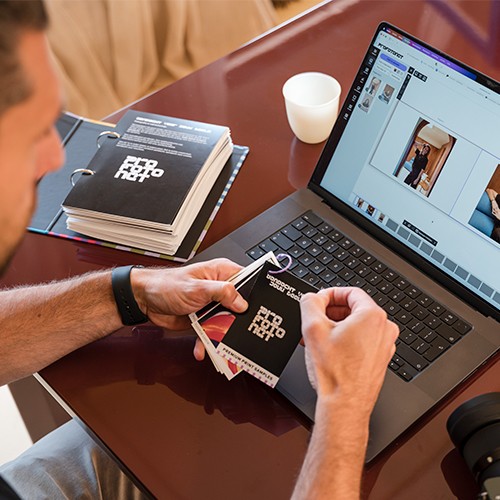
Ramon works with digital images all day long. Yet he also puts his best work on paper. Sometimes for himself. Sometimes as part of what he delivers to a client.

“A photograph on a screen is always competing with everything around it. On paper, it stands alone. You really look at it.”

Printing also changes the way he evaluates his own work. A photograph that looks strong on a screen can disappoint in print, and vice versa.

“For me, print is the ultimate test. If a photograph works on paper, I know it’s right.”

A hardcover photo book for projects that deserve to be preserved. Aluminium Dibond for photographs that deserve a place on the wall—at home, in a studio, or in a client’s office.

Not nostalgia. A deliberate way of giving images the weight they deserve.

Ramon orders at Profotonet
Photobook of shoot Ramon

What you can take away from this

Whether you photograph professionally or purely for yourself, Ramon’s approach offers lessons that apply to everyone.

  • Start with the story. What do you want to communicate? What should people feel when they see your photograph? Asking that question makes you more conscious of what you are creating and why.
  • Know your location. Explore it beforehand. Study the light, the angles, and the atmosphere. A location you know gives you freedom. A location you do not know creates stress.
  • Give your work a life beyond your computer. A photograph hidden in a folder is not a photograph that truly lives. Print your favourites. Create a book. Hang something on the wall. You will see your own work differently and often realise just how good it really is.